Top handle chainsaws are specialized tools for arborists and tree care professionals, designed for precision, maneuverability, and safety when working at height. Unlike traditional rear-handle chainsaws, their handle is positioned on top of the engine housing, enabling a compact and balanced design crucial for aerial tasks like pruning, crown reduction, and sectional felling. This configuration allows for precise cutting and, for trained professionals, cautious one-handed operation while maintaining three points of contact with the tree, significantly enhancing productivity and safety in elevated environments.
Overview of Top Handle Chainsaws
A top handle chainsaw is a distinct class of chainsaw specifically designed for professional arborists, tree surgeons, and anyone performing tree work at height. Their defining characteristic is the handle positioned on top of the engine housing, which allows for a compact and balanced design. This configuration is crucial for precise cutting, optimal maneuverability within dense tree crowns, and even cautious one-handed operation by trained professionals while maintaining three points of contact with the tree.
Historically, chainsaws were primarily heavy, rear-handle tools used for felling large timber from the ground. As arboriculture evolved, the need for lighter, more agile saws became apparent for tasks like pruning, crown reduction, and sectional felling in aerial environments. The top handle design emerged to meet this demand, prioritizing ease of use and safety in challenging, elevated workspaces. For see our chainsaw sales recommendations on this site.
Today, the market offers a diverse range of top handle chainsaws, broadly categorized by their power source: gasoline, electric corded (less common for aerial work due to tethering), and battery-powered. Each type presents unique advantages and trade-offs, making the selection process a critical decision for any professional arborist. The evolution of battery technology, in particular, has introduced powerful, emission-free alternatives that are increasingly popular in urban and noise-sensitive environments.
Factors to Consider When Buying a Top Handle Chainsaw
Selecting the ideal top handle chainsaw requires a thorough understanding of your specific needs and the features that directly impact performance, safety, and comfort during aerial work. It’s a balance between raw power and nimble design.
Type of Chainsaw
The primary distinction among top handle chainsaws lies in their power source, each bringing its own set of benefits and limitations.
-
Gas-Powered Chainsaws: These saws typically offer the highest power-to-weight ratio and unlimited runtime, making them the traditional choice for heavy commercial work and remote locations without access to charging. They excel in cutting large sections and dense hardwoods, maintaining consistent performance across various temperatures. However, they require fuel mixing, produce emissions and noise, and demand more regular maintenance. Starting can also be a physical effort, which is a consideration when repeatedly starting the saw in a tree.
-
Battery-Powered Chainsaws: Modern battery chainsaws, particularly with advanced lithium-ion technology, offer impressive performance with zero emissions, significantly reduced noise, and lower vibration. They are ideal for urban areas, noise-sensitive environments, and indoor work. Instant starting eliminates pull-cord frustrations, and minimal maintenance simplifies upkeep. The primary downsides are limited runtime, necessitating multiple batteries for extended work, and the added weight and cost of those batteries. Cold weather can also impact battery capacity.
“The shift towards battery-powered top handle chainsaws is undeniable, especially for urban arborists. The quiet operation and lack of fumes make a huge difference in residential areas.” – ReviewsThis.com Admin, Veteran Chainsaw Technician
Size and Weight
|
Our Picks for the Best Chain Saw in 2026
As an Amazon Associate I earn from qualifying purchases.
|
||
| Num | Product | Action |
|---|---|---|
| 1 | Stihl GTA 26 Wood Cutter with AS 2 Battery and Charger AL 1, Battery Operated |

|
| 2 | Oregon 3-Pack Chainsaw Chain 3/8" LP Pitch, .050" (1.3 mm) Gauge for 18" (45cm) Bar, 62 Drive Links – Low-kickback Replacement Saw Chain, Fits Husqvarna, Echo, Poulan, Homelite, Craftsman and more |
|
| 3 | Makita-UC4051A Chain Saw, Electric, 16 in. Bar - Sliver |
|
| 4 | Greenworks 24V 12" Brushless Cordless Compact Chainsaw (Great For Storm Clean-Up, Pruning, and Firewood / 125+ Compatible Tools), Tool Only |
|
| 5 | Greenworks 24V 10" Cordless Compact Chainsaw (Great For Storm Clean-Up, Pruning, and Firewood), 2.0Ah Battery and Charger Included |
|
| 6 | Gas Chainsaw 62CC 20 Inch Professional Powerful 2-Stroke Engine for Tree Cutting, Logging and Firewood with Chain Brake |
|
| 7 | Greenworks 80V 16" Brushless Cordless Chainsaw (Great For Tree Felling, Limbing, Pruning, and Firewood / 75+ Compatible Tools), Tool Only |
|
| 8 | STIHL Battery Operated Chainsaw with Sound Kids Toy |
|
| 9 | Makita XCU03PT1 18V X2 (36V) LXT Lithium-Ion Brushless Cordless 14" Chain Saw Kit with, 4 Batteries (5.0Ah) |
|
| 10 | Husqvarna 450 Rancher 20 Inch Gas Chainsaw, 50.2-cc 3.2-HP, 2-Cycle X-Torq Engine, For Tree Pruning, Yard Cleanups and Firewood Cutting, 970613120 |
|
For tree climbing, the size and weight of your chainsaw are paramount. A lighter saw reduces operator fatigue during extended periods aloft, enhancing control and safety. A compact design allows for greater maneuverability through tight branch structures.
Choosing the right size involves balancing cutting capacity with handling ease. While a smaller, lighter saw (e.g., 25cc or equivalent battery model) is excellent for precision pruning and crown thinning, it might struggle with larger diameter timber. Conversely, a larger saw (e.g., 35-40cc or powerful battery equivalent) offers more power for heavy section removal but will be heavier and potentially more cumbersome in intricate spaces. Professionals often consider saws in the 2.3kg to 3.8kg (5-8 lbs) range (powerhead only) to strike an optimal balance.
Power and Bar Length
The power output of a top handle chainsaw directly correlates to its engine displacement (for gas models, typically 25cc to 40cc) or voltage/wattage (for battery models). This power determines the saw’s ability to cut through different wood types and diameters efficiently.
-
Engine Size for Gas Saws:
- 25-27cc: Best for precision pruning, light trimming, and branches up to 6 inches (150mm) in diameter. Ideal where weight savings are critical.
- 30-35cc: The “sweet spot” for many professional arborists, offering sufficient power for most tree work, including medium-sized felling and crown reductions, handling branches up to 10 inches (250mm).
- 35-40cc: For heavy commercial work, section removal, and large diameter cutting, though these will be heavier.
-
Bar Length: This influences both cutting capacity and maneuverability.
- 10-inch (25cm) bars: Offer maximum agility for precision work in dense crowns but limit cutting to smaller timber.
- 12-inch (30cm) bars: Considered the professional standard, providing a good balance of capacity (up to 12 inches/300mm diameter) and handling.
- 14-inch (35cm) bars: Provide extended capacity for occasional larger work but can compromise maneuverability.
Match the power and bar length to your typical work profile. A versatile 12-inch bar is often recommended as a starting point.
Safety Features
Safety is paramount when operating chainsaws, especially at height. Top handle chainsaws incorporate specialized features to protect the operator.
- Chain Brake System: This critical feature immediately stops chain rotation in milliseconds, typically activated by inertial forces during kickback or manually by the operator.
- Throttle Lockout: Prevents accidental throttle engagement, requiring a deliberate two-stage activation to operate the saw.
- Chain Catcher: A small projection designed to catch the chain if it breaks or derails, protecting the operator.
- Right-Hand Guard: Shields the operator’s hand from debris and chain contact.
- Anti-Vibration System: Reduces hand and arm strain, crucial for prolonged use, preventing conditions like Hand-Arm Vibration Syndrome (HAVS).
- Lanyard Attachment Point: A sturdy point to securely fasten the saw to a climbing harness, preventing accidental drops.
Beyond integrated saw features, personal protective equipment (PPE) is non-negotiable. This includes a climbing harness, hard hat with face shield, chainsaw chaps or pants (all-around leg protection recommended for climbing), cut-resistant gloves, steel-toe boots, and hearing protection.
Brand and Price
The market for professional top handle chainsaws is dominated by reputable brands known for their quality, reliability, and innovation.
- Stihl and Husqvarna: These European brands are often considered industry leaders, known for their robust engineering, powerful engines, and extensive dealer networks. They offer premium saws with advanced technologies.
- Echo and Makita: Japanese manufacturers renowned for precision engineering, lightweight designs, and increasingly strong battery-powered options. Echo is often praised for its excellent power-to-weight ratio, while Makita leverages its vast battery ecosystem.
- Mitox and other “Value” Brands: Offer more budget-friendly options that can provide adequate performance for occasional professional use or as backup saws, though they may not match premium brands in longevity or advanced features.
Prices for professional top handle chainsaws can range significantly, from entry-level options around £89-£150 to premium models costing £400-£900 or more. Consider the total cost of ownership, including fuel, oil, maintenance, and the lifespan of the tool, rather than just the initial purchase price. Investing in a higher-quality saw often yields better long-term value through improved reliability and productivity.
Comparison of Popular Top Handle Chainsaw Models
| Feature | Stihl MS 201 TC-M | Echo CS-2511TES X-Series | Husqvarna T435 | Echo DCS 2500T (Battery) | Makita DUC256Z / XCU08PT (Battery) |
|---|---|---|---|---|---|
| Power Source | Gas (Petrol) | Gas (Petrol) | Gas (Petrol) | Battery (50.4V) | Battery (Twin 18V/36V) |
| Engine/Motor | 35.2cc, 1.8kW | 25.0cc, 1.1kW | 35.2cc, 1.5kW (2.01hp) | Brushless Motor | Brushless Motor |
| Bar Length Options | 12-14 inches (30-35cm) | 10 inches (25cm) | 12-14 inches (30-35cm) | 12 inches (30cm) | 10 inches (25cm) |
| Weight (Powerhead/Dry) | 2.6 kg (5.7 lbs) | 2.3 kg (5.1 lbs) | 3.4 kg (7.5 lbs) | 3.4 kg (7.5 lbs) with 2.5Ah battery | 3.3 kg (7.3 lbs) without batteries |
| Key Features | M-Tronic (electronic engine management), outstanding power-to-weight, anti-vibration system, tool-free chain tensioning, exceptional fuel efficiency. | Ultra-lightweight, G-Force Engine Air Pre-Cleaner, automatic fast idle, clutch-driven adjustable oiler, excellent ergonomics, swing-out lanyard ring. | X-Torq engine, LowVib anti-vibration, SmartStart, adjustable oil pump, good balance, durable. | Fast and powerful, compact, can be run one-handed (trained users), long battery life (65 cuts on 6-inch log), automatic oiler. | Quiet operation, zero emissions, instant start, compatible with Makita LXT battery ecosystem, tool-free side chain tensioning, adjustable auto-oiler. |
| Ideal Use | Professional, demanding commercial applications, heavy section removal. | Elite arborists, extensive work at height, precision pruning, weight-sensitive tasks. | All-round professional, varied tree work, park pruning, orchard maintenance. | Urban arborists, noise-sensitive areas, general tree climbing, powerful battery performance. | Urban tree work, noise-sensitive locations, existing Makita battery users, quiet and emission-free operation. |
| Pros | Exceptional power, reliable, advanced engine technology, highly durable. | Lightest petrol saw, superb power-to-weight, excellent ergonomics, reliable. | Proven reliability, good power-to-weight, effective vibration dampening, fuel-efficient. | Very fast cutting, good battery life for a cordless top handle, convenient, low maintenance. | Silent, no fumes, instant start, part of a wide battery system, reduced vibration. |
| Cons | Premium price, requires specialized dealer service, learning curve for M-Tronic. | Small bar length limitation, premium price, specialist dealer availability. | Heavier than ultra-light options, standard features compared to newer models. | Expensive, battery overheating possible under heavy, continuous load, only for experienced users. | Batteries sold separately (high initial cost), limited runtime compared to gas, battery weight affects balance. |
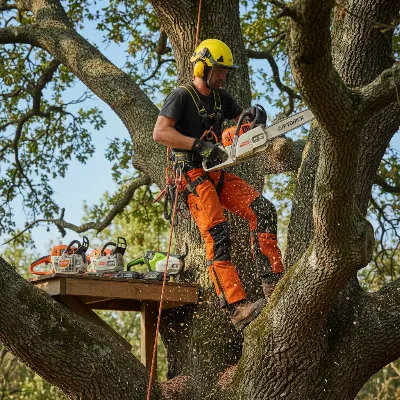 An arborist climbing a large tree, using a top handle chainsaw to prune branches, with various chainsaws in the background for comparison.
Stihl MS 201 TC-M: The Professional Benchmark
For arborists who demand uncompromising power and precision, the Stihl MS 201 TC-M continues to set the standard. Its M-Tronic technology provides optimal fuel mixture, ensuring consistent performance even in varying conditions and at different altitudes. This saw boasts an exceptional power-to-weight ratio (2.6 kg dry weight) and superior cutting capabilities, making it a favorite for demanding tasks like heavy section removal and crown reductions. While its premium price and need for authorized dealer service are factors, the investment is often justified by its proven reliability and productivity in commercial applications.
Echo CS-2511TES X-Series: The Lightweight Champion
The Echo CS-2511TES is renowned for being the lightest professional petrol top handle chainsaw available, weighing a remarkable 2.3 kg (dry). This featherlight design, combined with its 25cc professional 2-stroke engine, delivers astonishing power, making it a top choice for arborists who spend extended hours working at height. Its compact, ergonomic design, G-Force Engine Air Pre-Cleaner, and clutch-driven adjustable oiler are testaments to Japanese engineering precision. While the 10-inch bar might limit some applications, its exceptional maneuverability and reduced fatigue make it ideal for intricate crown work.
Husqvarna T435: The Reliable Workhorse
Husqvarna’s T435 shows Swedish engineering, offering a well-balanced and reliable saw capable of handling a broad range of arboricultural tasks. Its 35.2cc X-Torq engine delivers strong power while improving fuel efficiency and reducing emissions. Features like LowVib anti-vibration technology and SmartStart for easier ignition significantly enhance operator comfort during long workdays. The T435’s ability to accommodate 12-14 inch bars makes it a versatile all-rounder, favored by professionals who need a dependable saw for park pruning, orchard maintenance, and medium-sized felling.
Echo DCS 2500T: Battery Power, Professional Performance
The Echo DCS 2500T stands out as a leading battery-powered top handle chainsaw, impressing with its speed and cutting power. Operating on a 50.4V system, it combines a 12-inch bar with a robust brushless motor, delivering performance that rivals many gas models. Its ability to be run one-handed (for trained users) and compact design make it incredibly handy for urban arborists or those working in noise-sensitive environments where emissions are a concern. While it’s an investment, its instant start, reduced maintenance, and zero emissions offer significant operational advantages.
Makita DUC256Z / XCU08PT: Cordless Convenience in the Canopy
The Makita DUC256Z (also known as XCU08PT) represents the modern era of cordless arboricultural equipment, leveraging Makita’s extensive 18V LXT battery ecosystem. Its dual 18V (36V equivalent) brushless motor delivers impressive power for a battery saw, with a boost mode for extra performance on demand. Ideal for urban tree work, it offers silent operation, zero emissions, and instant starting, eliminating the hassles of petrol. Though the initial investment can be higher due to batteries being sold separately, its minimal maintenance and environmental benefits make it a strong contender for progressive tree surgeons embracing cordless technology.
Chain Saw Buying Guide
Navigating the options for top handle chainsaws can be overwhelming. A structured approach ensures you invest in a tool that truly meets your professional demands.
Determine Your Usage Needs
Before anything else, clearly define the types of work you will be undertaking.
- Primary Tasks: Are you primarily focused on delicate pruning and crown thinning, or do your jobs often involve heavier crown reductions and sectional felling of larger limbs?
- Frequency of Use: Will this be a daily workhorse, an occasional tool for specific jobs, or a reliable backup?
- Work Environment: Do you frequently work in residential areas or urban settings where noise and emissions are critical concerns, or in remote, rural locations where runtime and raw power are paramount?
- Tree Species: Will you mostly be cutting softer woods, or will you encounter dense hardwoods regularly?
For light, precise pruning, a lighter saw with a 10-inch bar (like the Echo CS-2511TES or a battery equivalent) might be perfect. If you tackle more varied work with larger branches, a 12-inch bar with a 30-35cc engine or a powerful battery saw might be more suitable.
Establish Your Budget
Chainsaws represent a significant investment, but higher cost often correlates with superior performance, durability, and advanced features.
- Entry-Level (Budget-conscious): While some budget options exist, for professional top-handle work, it’s generally recommended to invest in mid-to-premium range saws. Budget saws might serve as backups but typically lack the longevity and refined features for daily professional use.
- Mid-Range: Offers a balance of quality, features, and durability. These saws provide excellent value for professional use, with good power-to-weight ratios and reliable performance.
- Premium: Represents the top tier in performance, technology, and build quality. These saws are designed for heavy daily use, offering advanced engine management, superior vibration dampening, and exceptional longevity. While the upfront cost is higher, their extended lifespan and reduced downtime often result in a lower total cost of ownership over many years. Factor in the cost of necessary accessories like extra batteries for cordless models.
Conduct Thorough Research
Once you have a clear idea of your needs and budget, dive into detailed research.
- Read Reviews and Comparisons: Look for independent reviews, expert analyses, and direct product comparisons from reputable sources. Pay attention to feedback from other professional arborists.
- Consult User Opinions: Online forums and communities dedicated to arboriculture can provide invaluable real-world insights into the performance, reliability, and quirks of specific models.
- Stay Updated: Chainsaw technology evolves. Look for information that is current to ensure you are considering the latest models and features.
Purchase from Reputable Sources
Where you buy your chainsaw is almost as important as which chainsaw you choose.
- Authorized Dealers: For premium brands like Stihl and Husqvarna, purchasing from authorized dealers ensures you receive genuine products, access to specialized service, original parts, and valid warranties. Dealers often offer expert advice and can help with initial setup.
- Online Retailers (with caution): For some brands or certain models, reputable online retailers can offer competitive pricing. However, verify their return policies, warranty support, and ensure they are selling legitimate products. Be wary of unbranded or suspiciously cheap alternatives.
- Warranty and Support: Always check the warranty policy and the availability of local service and parts. This is crucial for minimizing downtime and protecting your investment.
Tips for Using and Maintaining Your Top Handle Chainsaw
Maximizing the lifespan and ensuring the safe operation of your top handle chainsaw hinges on proper usage and consistent maintenance.
Safe Chainsaw Operation
Safety should always be your top priority, especially when working aloft.
- Training and Certification: Never operate a top handle chainsaw without proper professional training and certification. These tools are designed for off-ground use by skilled arborists.
- Pre-Operation Checklist: Before each use, perform a thorough inspection:
- Verify chain sharpness and tension.
- Check bar oil level and ensure proper flow.
- Inspect fuel/battery level.
- Clean the air filter.
- Test the chain brake and throttle lockout mechanisms.
- Ensure all fasteners are secure and handles are intact.
- Proper Grip and Stance: Maintain a firm grip with both hands when possible, and ensure the saw is balanced. When one-handed operation is necessary (by trained professionals), ensure you have at least three points of contact with the tree.
- Awareness: Always be aware of your surroundings, potential kickback, falling debris, and the location of fellow crew members.
- PPE: Consistently wear all required personal protective equipment (PPE), including a climbing helmet, hearing and eye protection, chainsaw chaps, cut-resistant gloves, and steel-toe boots.
Essential Maintenance to Extend Lifespan
Regular maintenance prevents costly breakdowns and ensures your saw performs optimally.
- Daily Cleaning: After each use, clean sawdust, sap, and debris from the cooling fins, chain brake mechanism, and bar groove.
- Chain Sharpening and Replacement: A sharp chain is a safe and efficient chain. Learn to hand-file your chain using the correct file size. Replace chains when they are worn beyond their service limits or have significant damage. Dull chains increase effort, create fine sawdust instead of chips, and increase kickback risk.
- Bar Maintenance: Regularly clean the bar groove and oil holes. Flip the guide bar periodically to ensure even wear, extending its life.
- Air Filter: Clean or replace the air filter regularly, especially in dusty conditions, to ensure optimal engine performance and longevity.
- Spark Plug (Gas Saws): Inspect and replace the spark plug as needed to maintain efficient combustion.
- Fuel and Oil (Gas Saws): Use the correct fuel mixture (fresh fuel only) and high-quality bar oil.
- Battery Care (Battery Saws): Follow manufacturer guidelines for charging and storing batteries to maximize their lifespan. Avoid extreme temperatures.
- Professional Servicing: Schedule annual professional servicing with an authorized dealer, or every 50-100 operating hours, whichever comes first. This ensures internal components are inspected and complex adjustments are made by trained technicians.
Common Issues and Troubleshooting
- Saw Not Starting/Running Poorly: For gas saws, check fuel (fresh, correct mix), spark plug, and air filter. For battery saws, check battery charge and condition.
- Chain Not Moving/Binding: Check chain tension (too tight or too loose), bar oil level, and for any debris in the bar groove.
- Smoking Chain: Typically indicates insufficient bar oil or a dull chain putting too much friction on the bar.
- Excessive Vibration: Can be a dull chain, improper chain tension, or worn anti-vibration mounts.
Addressing these issues promptly can prevent more significant problems and extend the life of your valuable tool.
The Most Popular Top Handle Chainsaws Today
As we look towards 2026, several top handle chainsaws continue to dominate the professional arborist market, earning their reputation through performance, reliability, and innovation.
- Stihl MS 201 TC-M: Still widely regarded as the benchmark for professional gas top handle chainsaws, it’s favored for its powerful engine, M-Tronic technology, and exceptional durability, making it a staple for experienced arborists tackling demanding tasks.
- Echo CS-2511T/TES: This ultra-lightweight gas chainsaw remains incredibly popular for its unmatched power-to-weight ratio and superb maneuverability. It’s the go-to choice for climbers prioritizing reduced fatigue during long hours of intricate work in the canopy.
- Husqvarna T540 XP Mark III / T540i XP: Husqvarna’s offerings, particularly the T540 series, are highly regarded. The gas T540 XP Mark III is celebrated for its modern engine technology and ergonomic design, while the battery-powered T540i XP is a leading cordless option, offering performance equivalent to a 40cc gas saw with zero emissions and exceptional balance, making it a major upgrade for many arborists.
- Echo DCS 2500T: A strong contender in the battery segment, this model is consistently praised for its impressive cutting speed, power, and compact design, providing a viable and efficient cordless solution for professional tree climbing.
- Makita XCU08PT (DUC256Z): Leveraging Makita’s robust battery platform, this top handle chainsaw is gaining significant traction, especially among arborists already invested in the Makita ecosystem. Its quiet operation, instant start, and consistent power make it an excellent choice for urban tree care.
These models represent a blend of proven gas power and advanced battery technology, offering arborists diverse options to match their specific operational needs and environmental considerations. Each has garnered strong professional endorsements for their performance in the demanding world of tree climbing.
Conclusion
The top handle chainsaw is a critical tool for any arborist or tree climbing professional, designed with unique features that enable safe, efficient, and precise work at height. As we’ve explored, factors like power source (gas vs. battery), weight, engine size, bar length, and safety features are paramount in making the right choice. Leading brands like Stihl, Echo, Husqvarna, and Makita continue to innovate, offering powerful and ergonomic solutions for every arborist’s specific needs.
The best top handle chainsaw isn’t necessarily the most expensive or the most powerful on paper. It’s the one that perfectly aligns with your individual work demands, enhances your comfort, and, most importantly, keeps you safe in the canopy. Prioritize comprehensive training and adhere to stringent safety protocols regardless of the model you choose. Your commitment to quality equipment and safe practices will ultimately define your success and longevity in the demanding but rewarding world of tree care.
What specific tree climbing challenges are you hoping a new top handle chainsaw will help you overcome this year?
Frequently Asked Questions
What makes top handle chainsaws different from regular chainsaws?
Top handle chainsaws are specifically designed for arborists working at height. Their handle is positioned on top of the engine, allowing for better balance, control, and potential one-handed operation (by trained professionals) when climbing. They are typically lighter, more compact, and optimized for precision cutting in confined spaces, unlike rear-handle saws meant for ground-level felling.
Are battery-powered top handle chainsaws powerful enough for professional use?
Yes, modern battery-powered top handle chainsaws have significantly advanced and are now powerful enough for many professional applications. Models like the Echo DCS 2500T or Husqvarna T540i XP offer performance comparable to 30-40cc gas saws. They excel in urban environments due to zero emissions and quieter operation, though professionals often carry multiple batteries for extended runtime.
What safety gear is essential when using a top handle chainsaw for tree climbing?
Essential safety gear includes a climbing helmet with face shield and hearing protection, a climbing harness, chainsaw chaps (preferably all-around leg protection for climbing), cut-resistant gloves, and steel-toe boots. Proper training and certification are also legally required for professional use in many regions.
How often should top handle chainsaws be serviced?
Professional top handle chainsaws require daily operator checks (chain tension, oil levels, air filter, chain brake). Beyond daily maintenance, comprehensive servicing by authorized dealers is recommended annually or every 50-100 operating hours for full-time professional use, to ensure optimal performance and longevity.
What is the ideal bar length for a top handle chainsaw used in tree climbing?
Most arborists find that a 12-inch (30cm) bar length offers the best balance of cutting capacity and maneuverability for general tree climbing work. Shorter 10-inch bars are excellent for extreme precision and tight spaces, while longer 14-inch bars can handle larger cuts but may reduce agility.
Frequently Asked Questions
What makes top handle chainsaws different from regular chainsaws?
Top handle chainsaws are specifically designed for arborists working at height. Their handle is positioned on top of the engine, allowing for better balance, control, and potential one-handed operation (by trained professionals) when climbing. They are typically lighter, more compact, and optimized for precision cutting in confined spaces, unlike rear-handle saws meant for ground-level felling.
Are battery-powered top handle chainsaws powerful enough for professional use?
Yes, modern battery-powered top handle chainsaws have significantly advanced and are now powerful enough for many professional applications. Models like the Echo DCS 2500T or Husqvarna T540i XP offer performance comparable to 30-40cc gas saws. They excel in urban environments due to zero emissions and quieter operation, though professionals often carry multiple batteries for extended runtime.
What safety gear is essential when using a top handle chainsaw for tree climbing?
Essential safety gear includes a climbing helmet with face shield and hearing protection, a climbing harness, chainsaw chaps (preferably all-around leg protection for climbing), cut-resistant gloves, and steel-toe boots. Proper training and certification are also legally required for professional use in many regions.
How often should top handle chainsaws be serviced?
Professional top handle chainsaws require daily operator checks (chain tension, oil levels, air filter, chain brake). Beyond daily maintenance, comprehensive servicing by authorized dealers is recommended annually or every 50-100 operating hours for full-time professional use, to ensure optimal performance and longevity.
What is the ideal bar length for a top handle chainsaw used in tree climbing?
Most arborists find that a 12-inch (30cm) bar length offers the best balance of cutting capacity and maneuverability for general tree climbing work. Shorter 10-inch bars are excellent for extreme precision and tight spaces, while longer 14-inch bars can handle larger cuts but may reduce agility.
How to Choose a Top Handle Chainsaw
Selecting the right top handle chainsaw involves evaluating your specific work needs, budget, and conducting thorough research to ensure you invest in a tool that maximizes safety and efficiency for tree climbing.
Clearly define your primary tasks, frequency of use, work environment (urban vs. remote), and typical tree species. This helps determine the required power, weight, and bar length for your chainsaw. For example, delicate pruning might require a lighter saw with a 10-inch bar, while heavier work needs a 12-inch bar and a 30-35cc engine or powerful battery equivalent.
Chainsaws are a significant investment, with prices ranging from u00a389-u00a3150 for entry-level to u00a3400-u00a3900+ for premium models. While budget options exist, professional top-handle work generally benefits from mid-to-premium range saws due to superior performance, durability, and advanced features. Factor in the total cost of ownership, including accessories like extra batteries for cordless models.
Once needs and budget are clear, research specific models by reading independent reviews, expert analyses, and product comparisons from reputable sources. Consult online forums and communities dedicated to arboriculture for real-world insights into performance and reliability. Stay updated on current models and features to make an informed decision.
Buy from authorized dealers for premium brands like Stihl and Husqvarna to ensure genuine products, specialized service, original parts, and valid warranties. For other brands, reputable online retailers can offer competitive pricing, but always verify return policies and warranty support. Ensure local service and parts availability to minimize downtime and protect your investment.

As a professional arborist, the discussion about cautious one-handed operation really resonated. While it’s not something you do constantly, having that capability for quick, precise snips while maintaining grip is invaluable. My new Makita top handle has excellent balance, which makes those delicate cuts during pruning much safer and more efficient. Great tool for anyone serious about tree work.
I’ve been using top handle chainsaws for years in my tree care business, and the emphasis on maneuverability in the guide really hit home. It’s absolutely essential when you’re up in a canopy trying to make precise cuts without losing your balance. My latest Stihl top handle has been a game-changer for crown reduction work, making those awkward angles much easier to manage. Definitely recommend investing in a good one if you’re serious about aerial tasks.
I appreciate the breakdown of how these saws enhance safety with the three points of contact rule. I’ve been using a Husqvarna T540 XP for sectional felling, and while it’s powerful, I’ve found it to be a bit heavier than I expected, which can be tiring on longer jobs. It’s still a good saw, but the weight is something to consider if you’re doing all-day work.
This guide was super helpful in explaining why top handle chainsaws are different from traditional rear-handle models. I recently got one for some extensive pruning on my property, and the compact design is fantastic for getting into tight spots. My only minor complaint is that the fuel cap on my Echo can be a bit fiddly to open with gloves on, but overall, it’s a solid tool for working at height.