Sharpening your chainsaw blade at home is a skill every owner can master, transforming a sluggish tool into a precise cutting instrument. A sharp chainsaw is not just about efficiency; it’s about safety and control, reducing the risk of kickback and extending the life of your tool. This guide details the essential steps and techniques, ensuring your chainsaw is always ready to tackle any task with ease and confidence.
Recognizing a Dull Chainsaw Blade and Why Sharpening Matters
Knowing when your chainsaw blade needs attention is the first step towards maintaining peak performance. A dull blade can turn simple tasks into arduous struggles and significantly increase the risk of accidents.
Look for these telltale signs that your chainsaw chain requires sharpening: For chainsaw sales buying guides on this site.
- Increased Cutting Resistance: You’ll find yourself applying more pressure to force the chainsaw through wood, indicating the chain isn’t biting effectively. A sharp chain should glide effortlessly.
- Rough or Jagged Cuts: Instead of clean, smooth cuts, a dull chain leaves behind uneven, splintered wood. This not only looks unprofessional but can also compromise the integrity of the timber.
- Fine Sawdust Instead of Coarse Chips: A sharp chain carves out coarse, curly wood chips. If your saw produces powdery sawdust, it’s pulverizing the wood rather than cutting it, a clear sign of dullness.
- Smoke or Burning Smell: Even with adequate lubrication, a dull chain generates excessive friction as it struggles, leading to overheating, smoke, and a distinct burning odor. This can damage both the chain and the guide bar.
- Frequent Stalling: A chain that isn’t sharp enough can bind in the wood, causing the motor to stall repeatedly, interrupting your workflow and causing frustration.
- Chainsaw Pulls to One Side: If your saw consistently veers to one side during a cut, it often means the teeth on one side are duller or unevenly sharpened compared to the other.
- Excessive Vibration or Bouncing: A dull chain can cause the saw to vibrate more intensely and bounce off the wood, making it harder to control and increasing operator fatigue.
Ignoring these signs isn’t just an inconvenience; it’s a safety hazard. A dull chain is a primary cause of kickback—the violent, unpredictable upward thrust of the guide bar—which can lead to serious injury. A sharp blade reduces strain on the chainsaw’s engine and other components, extending the life of your valuable tool. Timely sharpening ensures efficient, safer, and more satisfying work.
Essential Tools for DIY Chainsaw Blade Sharpening
Before you begin sharpening, gathering the right tools is crucial. Having the correct equipment will make the process more accurate, efficient, and safe.
Round Files
|
Our Picks for the Best Chain Saw in 2026
As an Amazon Associate I earn from qualifying purchases.
|
||
| Num | Product | Action |
|---|---|---|
| 1 | Stihl GTA 26 Wood Cutter with AS 2 Battery and Charger AL 1, Battery Operated |

|
| 2 | Makita-UC4051A Chain Saw, Electric, 16 in. Bar - Sliver |
|
| 3 | Husqvarna 450 Rancher 20 Inch Gas Chainsaw, 50.2-cc 3.2-HP, 2-Cycle X-Torq Engine, For Tree Pruning, Yard Cleanups and Firewood Cutting, 970613120 |
|
| 4 | Oregon 3-Pack Chainsaw Chain 3/8" LP Pitch, .050" (1.3 mm) Gauge for 18" (45cm) Bar, 62 Drive Links – Low-kickback Replacement Saw Chain, Fits Husqvarna, Echo, Poulan, Homelite, Craftsman and more |
|
| 5 | Greenworks 24V 12" Brushless Cordless Compact Chainsaw (Great For Storm Clean-Up, Pruning, and Firewood / 125+ Compatible Tools), Tool Only |
|
| 6 | Gas Chainsaw 62CC 20 Inch Professional Powerful 2-Stroke Engine for Tree Cutting, Logging and Firewood with Chain Brake |
|
| 7 | STIHL Battery Operated Chainsaw with Sound Kids Toy |
|
| 8 | Makita XCU03PT1 18V X2 (36V) LXT Lithium-Ion Brushless Cordless 14" Chain Saw Kit with, 4 Batteries (5.0Ah) |
|
| 9 | Greenworks 80V 16" Brushless Cordless Chainsaw (Great For Tree Felling, Limbing, Pruning, and Firewood / 75+ Compatible Tools), Tool Only |
|
| 10 | Greenworks 24V 10" Cordless Compact Chainsaw (Great For Storm Clean-Up, Pruning, and Firewood), 2.0Ah Battery and Charger Included |
|
These are the primary tools for sharpening the cutting edges of your chainsaw teeth. The key is to select a round file that precisely matches your chain’s pitch, which is typically found in your chainsaw’s manual or stamped on the guide bar. The file should fit snugly into the gullet of the tooth, with about 1/4 (25%) or 1/5 (20%) of its diameter protruding above the top plate of the tooth. Using the wrong size file can lead to improper sharpening and further damage to the chain.
Flat Files & Depth Gauges
Depth gauges, also known as rakers, are critical components that control how deep each tooth bites into the wood, determining the thickness of the wood chip. If your depth gauges are too high, the teeth won’t cut effectively. You’ll need a flat file and a specialized depth gauge tool (filing gauge) to ensure these are filed to the correct height. The depth gauge tool rests on the chain, indicating if the raker is too high. A flat file is then used to bring the raker flush with the gauge.
Filing Guides & Sharpening Kits
For beginners or those seeking more precision, filing guides and sharpening kits are invaluable. A filing guide, such as a 2-in-1 guide, helps maintain the correct sharpening angle and depth gauge setting simultaneously, simplifying the process. These guides often have markings that help you align the file correctly. Sharpening kits typically include a combination of round files, a flat file, a file handle, and a depth gauge tool, providing a complete solution for at-home maintenance.
Vise or Sharpening Clamp
A stable work platform is non-negotiable for safe and accurate sharpening. A bench vise or a specialized chainsaw sharpening clamp (which can be driven into a stump for field use) securely holds the chainsaw’s guide bar, preventing any movement during filing. This stability allows you to apply consistent pressure and maintain precise angles.
Personal Protective Equipment (PPE)
Safety should always be your top priority. Always wear heavy-duty gloves to protect your hands from sharp chain teeth and potential file slips. Eye protection, such as safety glasses or a face shield, is also essential to guard against metal shavings or debris.
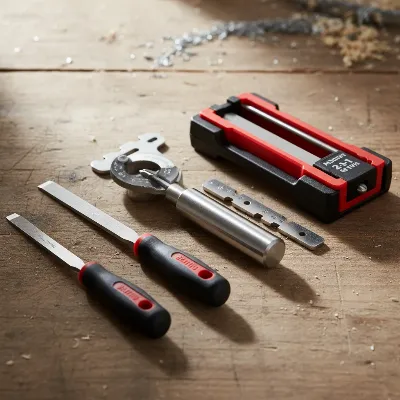 Assortment of essential chainsaw sharpening tools including files, depth gauge, and filing guide on a workbench.
Step-by-Step Guide to Sharpen Your Chainsaw Blade at Home
Sharpening a chainsaw blade manually is a methodical process that requires patience and precision. Follow these steps to achieve a razor-sharp edge.
Preparation and Safety First
Begin by ensuring your chainsaw is turned off and, if it’s an electric model, remove the battery pack or unplug it. Engage the chain brake to prevent accidental chain movement. Secure the chainsaw’s guide bar firmly in a vise or sharpening clamp, ensuring it won’t budge during filing. Before touching the chain, give it a quick clean to remove any sawdust, resin, or debris that could impede your view or clog your file. Finally, don your personal protective equipment: sturdy gloves and eye protection.
Identifying the Sharpening Angle
Most chainsaw chains require a sharpening angle between 25° and 35°, with 30° being a common standard for general cross-cutting. This angle is measured relative to the guide bar. Your chainsaw’s manual will specify the exact recommended angle for your particular chain type. Many filing guides have markings that correspond to these angles, making it easier to maintain consistency. If you’re free-handing it, aim for the angle that matches the existing bevel on the teeth as closely as possible.
Sharpening the Cutters with a Round File
- Locate Your Starting Point: Find the cutter tooth that is most worn or damaged, and mark it with a felt-tip pen. This will be your “master tooth” and your reference point for consistency. You will sharpen all teeth on one side first, then all teeth on the other.
- Position the File: Place the round file into the gullet of the marked tooth. Ensure that approximately 1/4 of the file’s diameter is above the top plate of the tooth. Angle the file according to your chain’s specified sharpening angle (e.g., 30°), keeping it at a 90-degree angle to the guide rail.
- File with Consistent Strokes: With a firm but controlled grip, push the file forward across the tooth. Only sharpen on the forward stroke; lift the file completely off the tooth on the backstroke to prevent dulling the file and damaging the tooth. Apply even pressure and count the number of strokes you use on your master tooth (typically 3-5 strokes are sufficient to remove dullness and achieve a shiny, silver edge).
- Rotate the File: To ensure even wear on your file, rotate it slightly after a few strokes or teeth.
- Repeat for All Teeth: Sharpen all the teeth facing the same direction, applying the exact same number of strokes and maintaining the consistent angle you established for the master tooth. This ensures all teeth are the same length and sharpness.
- Switch Sides: Once all teeth on one side are sharpened, unclamp, rotate the chainsaw 180 degrees, re-clamp, and repeat the process for all the teeth facing the opposite direction.
Filing the Depth Gauges (Rakers)
After sharpening the cutters, the depth gauges will likely need adjustment. As the cutters are filed down, they become shorter, which effectively increases the relative height of the depth gauge.
- Place the Depth Gauge Tool: Position the depth gauge tool over a sharpened cutter and its corresponding depth gauge (raker). If the raker protrudes above the tool, it needs to be filed down.
- File Horizontally: Using a flat file, carefully file the top of the depth gauge horizontally until it is flush with the depth gauge tool. Avoid touching the freshly sharpened edge of the tooth.
- Round the Edge: Lightly round the front edge of the raker with the flat file to restore its original shape. This helps prevent the chain from grabbing too aggressively.
- Repeat: Adjust all depth gauges on the chain to the same height.
Checking Your Work and Testing
Once all teeth and depth gauges have been addressed, perform a thorough visual inspection. Look for any light reflections along the edge of the teeth; a truly sharp edge will show no reflections. Ensure all teeth appear uniform in length and angle. For a final check, some experienced users can perform a “shaving test” on a piece of softwood, where a sharp blade should produce thin shavings easily. If any imperfections are found, re-file the affected teeth or rakers as needed.
Advanced Tips and Common Mistakes to Avoid
Mastering chainsaw sharpening involves more than just the basic steps; it’s about refining your technique and understanding common pitfalls.
Consistent Angles and Pressure
One of the most critical aspects of effective sharpening is maintaining a perfectly consistent angle and applying uniform pressure on every stroke. Even slight deviations can lead to uneven teeth, causing the chainsaw to cut crookedly or inefficiently. Tools like filing guides are excellent for ensuring this consistency, especially for those new to the task. Always push the file in one direction with steady force, lifting it on the return stroke.
Dealing with Damaged Teeth
Not all dullness is created equal. If your chain has hit a rock or dirt, some teeth might be severely damaged, chipped, or bent. Identify the most damaged tooth first and use it as your guide. File this tooth until all damage is removed, and then match the length of all other teeth to this newly shortened master tooth. However, there’s a limit to how much a tooth can be filed; if too much material needs to be removed, or if the tooth is severely broken, it might be safer to replace the entire chain or seek professional assessment.
Avoiding Over-Sharpening
While a sharp chain is good, over-sharpening can be detrimental. Aggressively filing too much material from the teeth not only shortens the lifespan of your chain but can also weaken them, making them prone to breakage. Count your strokes and aim for just enough filing to remove the dullness and reveal a new, shiny edge. Typically, 3-5 strokes per tooth are sufficient. Regular, light sharpening is better than infrequent, aggressive filing.
Understanding Different Tooth Types
Chainsaw chains come with various tooth designs, each suited for different tasks and requiring slightly different sharpening considerations:
- Semi-Chisel Chain: These teeth have rounded working corners, making them more forgiving in dirty wood, softwood, and general-purpose cutting. They are less prone to dulling quickly but cut slower.
- Full-Chisel Chain: Featuring sharp, square-cornered teeth, full-chisel chains are designed for fast cutting in clean hardwood. They cut aggressively but dull faster if they encounter dirt or hard objects.
- Tungsten-Tipped (Carbide) Chain: These specialized chains are extremely durable and used for cutting extremely hard wood or in abrasive conditions. They require diamond files or special grinding wheels for sharpening, as standard files won’t work effectively.
Always consult your chainsaw’s manual or the chain’s specifications to confirm its type and any specific sharpening recommendations.
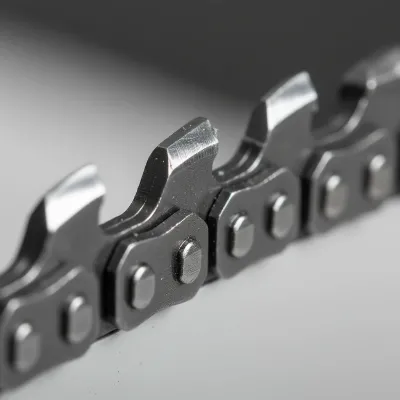 Close-up view of a chainsaw blade's teeth and depth gauges, showing a razor-sharp edge after sharpening.
Maintaining Your Chainsaw Blade’s Sharpness
Achieving a sharp blade is only half the battle; maintaining that sharpness and extending your chain’s life requires ongoing care and attention.
Regular Cleaning and Inspection
Make it a habit to clean your chainsaw chain after each use, especially before sharpening. Sawdust, sap, and oil residue can build up, hindering the sharpening process and causing premature wear. A wire brush and a solvent (like carburetor cleaner) can effectively remove gunk. Simultaneously, inspect the chain for any signs of damage—bent or broken teeth, excessive wear on the drive links, or stretched links. Addressing minor issues promptly can prevent them from escalating into bigger problems.
Proper Storage
When not in use, store your chainsaw and its chain properly. Apply a thin layer of chain oil to the chain to prevent rust, and store it in a clean, dry place. If you remove the chain from the bar for storage, ensure it’s coiled without kinks and protected from contact with other tools that could dull or damage its edges. Using a bar cover is also a simple yet effective way to protect the chain when it’s on the saw.
When to Seek Professional Sharpening or Replacement
While DIY sharpening is highly effective, there are situations where professional help or a new chain is the best option. Chains can typically be sharpened up to 10 times before they reach the end of their useful life. If the teeth become too short, the chain is severely damaged, or its geometry has significantly changed due to repeated sharpening, a professional can assess if it can be salvaged or if replacement is necessary. Professionals have specialized grinding equipment that can restore severely worn chains more uniformly than manual filing. Investing in a new chain when yours is beyond economical repair ensures optimal safety and performance.
“A sharp chainsaw blade isn’t just about cutting faster; it’s fundamentally about making every cut safer and more predictable. Neglecting blade sharpness is an open invitation for frustration and potential hazard.” – Admin, ReviewsThis.com, Chainsaw Technician with 10+ Years Experience
Conclusion
Mastering the art of sharpening your chainsaw blade at home is an invaluable skill that enhances both your productivity and safety. By understanding the signs of a dull blade, assembling the right tools, and following a precise step-by-step process for filing both cutters and depth gauges, you can consistently maintain a razor-sharp edge. Prioritize safety with proper preparation and protective gear, and refine your technique by focusing on consistent angles and avoiding common mistakes. Regular cleaning, proper storage, and knowing when to seek professional help will further extend the life and performance of your chain. Take control of your chainsaw’s performance; a sharp blade truly makes all the difference. What improvement have you noticed most since you started regularly sharpening your chainsaw blade?
Frequently Asked Questions
How often should I sharpen my chainsaw blade?
The frequency depends on usage and the type of wood you’re cutting. A general guideline is to sharpen after every 2-3 hours of continuous use or whenever you notice signs of dullness, such as increased cutting resistance or fine sawdust instead of chips. Hardwood or dirty wood will dull a chain faster than softwood.
Can I sharpen a chainsaw blade with a Dremel?
While some rotary tools with grinding stones can technically sharpen a chainsaw blade, it’s generally not recommended for beginners. Achieving the correct, consistent angle and depth with a Dremel can be challenging, leading to uneven sharpening and potential damage to the chain. Specialized chainsaw sharpeners or manual files are usually safer and more effective for DIY sharpening.
What is the best angle for sharpening a chainsaw blade?
Most chainsaw chains are sharpened at an angle between 25° and 35° relative to the guide bar, with 30° being a very common standard. For specific recommendations, always consult your chainsaw’s owner’s manual or the chain manufacturer’s specifications. Using a filing guide can help you maintain the correct angle consistently.
How do I know if my sharpening file is the right size?
The correct round file size should match your chainsaw chain’s pitch. This information is typically found in your chainsaw’s manual or stamped on the guide bar. When the file is placed in the tooth’s gullet, about 1/4 (25%) of its diameter should protrude above the top plate of the tooth.
What happens if I don’t file the depth gauges?
If you sharpen the cutting teeth but neglect to file the depth gauges (rakers), the depth gauges will become too high relative to the shortened cutters. This prevents the teeth from biting deeply enough into the wood, resulting in very thin or no chips, and makes the chainsaw cut inefficiently or not at all, essentially just skimming the wood surface.
Frequently Asked Questions
How often should I sharpen my chainsaw blade?
You should sharpen your chainsaw blade after every 2-3 hours of continuous use or whenever you notice signs of dullness, such as increased cutting resistance or fine sawdust instead of chips. Hardwood or dirty wood will dull a chain faster than softwood.
Can I sharpen a chainsaw blade with a Dremel tool?
While some rotary tools with grinding stones can technically sharpen a chainsaw blade, it's generally not recommended for beginners. Achieving the correct, consistent angle and depth with a Dremel can be challenging, potentially leading to uneven sharpening and damage. Specialized chainsaw sharpeners or manual files are usually safer and more effective for DIY sharpening.
What is the best angle for sharpening a chainsaw blade?
Most chainsaw chains are sharpened at an angle between 25u00b0 and 35u00b0 relative to the guide bar, with 30u00b0 being a very common standard for general cross-cutting. Always consult your chainsaw's owner's manual or the chain manufacturer's specifications for specific recommendations. Using a filing guide can help maintain the correct angle consistently.
How do I know if my sharpening file is the right size?
The correct round file size should precisely match your chainsaw chain's pitch, which is typically found in your chainsaw's manual or stamped on the guide bar. When the file is placed in the tooth's gullet, approximately 1/4 (25%) of its diameter should protrude above the top plate of the tooth.
What happens if I don't file the depth gauges after sharpening?
If you sharpen the cutting teeth but neglect to file the depth gauges (rakers), the depth gauges will become too high relative to the shortened cutters. This prevents the teeth from biting deeply enough into the wood, resulting in very thin or no chips, and makes the chainsaw cut inefficiently or not at all, essentially just skimming the wood surface.

The guide was mostly helpful, especially the part about reducing kickback. I tried sharpening my blade, but I still had a bit of trouble getting the angle just right on my smaller electric chainsaw. It’s better than it was, but not quite ‘razor sharp’ yet. Might need a bit more practice.
I’ve always put off sharpening my chainsaw, thinking it was too complicated. This guide made it so easy to understand the ‘increased cutting resistance’ sign. My old Stihl was really struggling, but after following the steps, it cuts like new. Definitely a game-changer for my weekend yard work.
This is exactly what I needed! I was noticing my chainsaw was producing more sawdust than chips, which the guide mentioned as a sign of a dull blade. I followed the DIY steps and now my Poulan Pro is cutting through logs like butter. So glad I found this before buying a new chain.
Great tips here! I appreciated the focus on safety and control, which is something I always worry about. I used to just buy new chains, but learning to sharpen them myself is going to save me a ton of money. My Husqvarna is back to being a beast.