The correct fuel mix for a 2-stroke chainsaw is crucial for optimal performance, engine longevity, and preventing costly damage. Most modern Stihl and Husqvarna chainsaws require a 50:1 fuel-to-oil ratio, meaning 50 parts gasoline to 1 part 2-stroke oil. Using the precise ratio specified in your chainsaw’s manual, along with high-quality, ethanol-free gasoline and specialized 2-stroke oil, ensures proper lubrication and combustion, extending the tool’s lifespan by years.
Understanding Your 2-Stroke Chainsaw’s Fuel Needs
Unlike 4-stroke engines that have a separate oil sump for lubrication, 2-stroke chainsaw engines rely on oil mixed directly into the gasoline. This fuel-oil blend serves a dual purpose: it provides the necessary combustion to power the engine and simultaneously lubricates its internal moving parts. The absence of an internal oil system makes the correct fuel mixture absolutely critical for preventing excessive wear, piston seizure, and ultimately, premature engine failure.
The precise fuel-to-oil ratio is paramount and is typically specified by your chainsaw’s manufacturer in the operator’s manual. While a 50:1 ratio is widely recommended for most modern Stihl and Husqvarna chainsaws, older models or certain brands may require a richer mix, such as 40:1 or even 32:1. Ignoring these specific recommendations can lead to detrimental consequences, either by over-oiling (causing excessive smoke and carbon buildup) or under-oiling (leading to catastrophic engine overheating and component damage). Always consult your chainsaw’s manual to confirm the exact ratio needed for your specific model.
Essential Components for Your Chainsaw Fuel Mix
Crafting the perfect fuel mix begins with selecting the right ingredients. Just as a chef wouldn’t compromise on quality components for a gourmet meal, you shouldn’t cut corners when it comes to your chainsaw’s lifeblood.
Selecting the Right Gasoline
The foundation of your fuel mix is high-quality, fresh, unleaded gasoline. Most manufacturers recommend a minimum octane rating of 89, though always defer to your owner’s manual for specific requirements. Critically, pay close attention to ethanol content. Gasoline containing more than 10% ethanol (E10) is generally not recommended for small engines, especially chainsaws, and can lead to significant problems. Ethanol is hygroscopic, meaning it attracts and absorbs water, which can separate from the gasoline and cause corrosion in your fuel system. It can also act as a solvent, degrading rubber and plastic components like fuel lines and carburetor diaphragms over time. Ideally, opt for ethanol-free gasoline whenever possible to protect your engine and prolong its life. Many specialized pre-mixed, ethanol-free fuels are also available, offering a convenient and reliable solution.
Choosing the Correct 2-Stroke Oil
|
Our Picks for the Best Chain Saw in 2026
As an Amazon Associate I earn from qualifying purchases.
|
||
| Num | Product | Action |
|---|---|---|
| 1 | Oregon 3-Pack Chainsaw Chain 3/8" LP Pitch, .050" (1.3 mm) Gauge for 18" (45cm) Bar, 62 Drive Links – Low-kickback Replacement Saw Chain, Fits Husqvarna, Echo, Poulan, Homelite, Craftsman and more |

|
| 2 | Husqvarna 450 Rancher 20 Inch Gas Chainsaw, 50.2-cc 3.2-HP, 2-Cycle X-Torq Engine, For Tree Pruning, Yard Cleanups and Firewood Cutting, 970613120 |
|
| 3 | Greenworks 24V 12" Brushless Cordless Compact Chainsaw (Great For Storm Clean-Up, Pruning, and Firewood / 125+ Compatible Tools), Tool Only |
|
| 4 | Gas Chainsaw 62CC 20 Inch Professional Powerful 2-Stroke Engine for Tree Cutting, Logging and Firewood with Chain Brake |
|
| 5 | Stihl GTA 26 Wood Cutter with AS 2 Battery and Charger AL 1, Battery Operated |
|
| 6 | Greenworks 24V 10" Cordless Compact Chainsaw (Great For Storm Clean-Up, Pruning, and Firewood), 2.0Ah Battery and Charger Included |
|
| 7 | Makita-UC4051A Chain Saw, Electric, 16 in. Bar - Sliver |
|
| 8 | Makita XCU03PT1 18V X2 (36V) LXT Lithium-Ion Brushless Cordless 14" Chain Saw Kit with, 4 Batteries (5.0Ah) |
|
| 9 | Greenworks 80V 16" Brushless Cordless Chainsaw (Great For Tree Felling, Limbing, Pruning, and Firewood / 75+ Compatible Tools), Tool Only |
|
| 10 | STIHL Battery Operated Chainsaw with Sound Kids Toy |
|
The oil you use for your 2-stroke chainsaw is not interchangeable with automotive motor oil. Two-stroke engines require specific oils designed to burn cleanly with gasoline, leaving minimal ash and deposits. Look for high-quality 2-stroke engine oil explicitly formulated for air-cooled engines. Key industry standards and certifications to look for include JASO FD or ISO-EGD. These ratings indicate superior detergency, which helps keep engine components clean and prevents carbon buildup, essential for the high-performance demands of a chainsaw. While TC-W3 oils are primarily designed for water-cooled marine engines, some oils carry both TC-W3 and JASO ratings. For optimal performance and engine longevity, always use a reputable brand of 2-stroke oil, preferably one recommended by your chainsaw’s manufacturer.
Step-by-Step Guide to Mixing Chainsaw Fuel Safely
Mixing fuel for your chainsaw is a straightforward process, but precision and adherence to safety guidelines are crucial.
Gathering Your Tools and Supplies
Before you begin, ensure you have all necessary items ready:
- Approved Fuel Container: Use a clean, brightly colored plastic or metal fuel can specifically designed for gasoline storage. Never use an old milk jug or water bottle.
- Measuring Cup/Syringe: A dedicated, clearly marked measuring cup or syringe for 2-stroke oil ensures accuracy.
- Fresh Unleaded Gasoline: As discussed, preferably ethanol-free.
- High-Quality 2-Stroke Oil: Suitable for air-cooled engines.
- Personal Protective Equipment (PPE): Safety glasses and chemical-resistant gloves are essential.
Precise Measurement and Initial Mix
Once your supplies are gathered, you’re ready to mix:
- Determine Your Ratio: Double-check your chainsaw’s manual for the exact fuel-to-oil ratio (e.g., 50:1, 40:1).
- Partially Fill with Gasoline: Pour approximately half of the total desired amount of gasoline into your approved fuel container. For instance, if you’re making 5 liters, add about 2.5 liters of gas first. This initial gasoline helps the oil mix more effectively and prevents it from settling at the bottom.
- Add the Oil: Carefully measure the correct amount of 2-stroke oil according to your chosen ratio and the amount of gasoline you’re mixing. Pour the entire measured quantity of oil into the fuel container.
- Initial Shake: Secure the cap on the fuel container tightly. Gently but thoroughly shake the container for about 30 seconds to ensure the oil and gasoline begin to emulsify.
Completing the Mix
After the initial mix, finish the process:
- Add Remaining Gasoline: Open the container and slowly add the remaining gasoline until you reach your desired total volume.
- Final Shake: Re-cap the container securely and shake it vigorously for another 30-60 seconds. You want to see a uniform, consistent color throughout the mixture, with no visible streaks or separation.
- Label: Clearly label the container with the date of mixing and the fuel-to-oil ratio (e.g., “50:1 Mix – 03/01/2026”). This prevents confusion and ensures you use fresh fuel.
Here’s a quick reference for common fuel-to-oil ratios:
| Ratio | Gasoline Volume (Liters) | Oil Volume (Milliliters) | Gasoline Volume (US Gallons) | Oil Volume (Fluid Ounces) |
|---|---|---|---|---|
| 50:1 | 1 | 20 | 1 | 2.6 |
| 40:1 | 1 | 25 | 1 | 3.2 |
| 32:1 | 1 | 31.25 | 1 | 4 |
> “The greatest challenge in mixing 2-stroke fuel isn’t the math, it’s maintaining absolute consistency. A little extra oil won’t ruin your day, but too little will definitely ruin your engine.” – Admin, ReviewsThis.com
Safety Precautions and Best Practices
Safety should always be your top priority when handling fuels and operating power equipment. A moment of carelessness can lead to serious injury or damage.
Personal Protective Equipment (PPE)
Always wear appropriate PPE when mixing or handling fuel.
- Safety Glasses: Protect your eyes from splashes or fumes.
- Chemical-Resistant Gloves: Prevent skin contact with gasoline and oil, which can cause irritation or absorption.
- Long Sleeves and Pants: Provide a barrier against accidental spills.
Safe Mixing Environment
Choose a safe location for mixing your fuel:
- Well-Ventilated Area: Mix outdoors or in a very well-ventilated space to avoid inhaling harmful fumes.
- Away from Ignition Sources: Ensure there are no open flames, sparks, hot surfaces, or smoking materials nearby. Gasoline vapors are highly flammable.
- Stable Surface: Place your fuel container on a flat, stable surface to prevent accidental spills.
Proper Storage of Mixed Fuel
Correct storage practices are vital for both safety and fuel integrity:
- Approved Containers: Always use sturdy, sealed fuel containers clearly marked for gasoline storage. Metal containers are often preferred for long-term storage as they are less porous than plastic.
- Limited Shelf Life: Mixed 2-stroke fuel has a limited shelf life, typically around 30 days. Beyond this, the gasoline can degrade, and ethanol (if present) can separate, leading to lubrication issues. Only mix what you expect to use within a month.
- Fuel Stabilizers: For extending the storage life of mixed fuel, consider adding a fuel stabilizer. Some stabilizers can extend freshness up to 12 months, though using freshly mixed fuel is always best.
- Cool, Dry Location: Store fuel in a cool, dry place, away from direct sunlight, extreme temperatures, and out of reach of children and pets.
- Drain Tanks for Storage: If your chainsaw will be stored for an extended period, drain its fuel tank and run the engine until it runs out of fuel. This prevents stale fuel from damaging the carburetor and fuel lines.
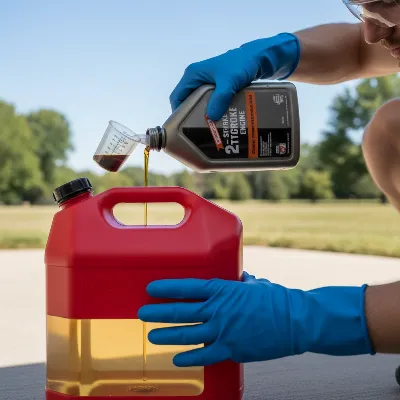 A person safely mixing 2-stroke chainsaw fuel in a well-ventilated outdoor area.
Common Mistakes to Avoid When Mixing Fuel
Even experienced users can make mistakes when it comes to fuel mixing. Being aware of these common pitfalls can save you significant headaches and repair costs.
- Using the Incorrect Ratio: This is arguably the most damaging mistake. Too little oil leads to overheating and engine seizure, while too much causes excessive smoke, carbon buildup, and reduced power. Always refer to your chainsaw’s manual.
- Using Old or Stale Fuel: Gasoline begins to degrade over time, especially when exposed to air. Stale fuel can cause starting difficulties, poor performance, and carburetor issues. Only use fresh gasoline, preferably purchased within the last 30 days.
- Using the Wrong Type of Oil: As previously mentioned, automotive engine oil is not suitable for 2-stroke chainsaws. Its composition is different and will not provide proper lubrication, leading to engine failure. Always use a dedicated 2-stroke oil for air-cooled engines.
- Ignoring Ethanol Warnings: Fuel containing ethanol, particularly in concentrations higher than E10, can wreak havoc on small engines. It can corrode metal components, degrade plastic and rubber, and absorb water, leading to phase separation and poor lubrication. Opt for ethanol-free fuel or pre-mixed options whenever possible.
- Improper Storage: Storing mixed fuel in unapproved containers, in direct sunlight, or for extended periods without stabilizer can lead to degradation, contamination, and safety hazards. Always use proper containers and adhere to storage guidelines.
- Mixing Directly in the Chainsaw Tank: Always mix fuel in a separate, approved fuel container, not directly in the chainsaw’s fuel tank. This ensures thorough mixing and prevents accidental overfilling or spills on the hot engine.
Conclusion
Mastering the art of mixing gas and oil for your 2-stroke chainsaw is a fundamental skill for any operator. By understanding the correct ratios, selecting high-quality gasoline and specialized 2-stroke oil, following precise mixing steps, and adhering to strict safety protocols, you can significantly prolong the life and optimize the performance of your valuable tool. that precision and fresh ingredients are your chainsaw’s best friends. Taking the time to properly prepare your fuel mix isn’t just a maintenance task; it’s an investment in your equipment’s longevity and your own safety. What small change will you make to your fuel mixing routine to ensure your chainsaw runs flawlessly every time?
Frequently Asked Questions
What is the most common fuel-to-oil ratio for chainsaws?
For most modern chainsaws from brands like Stihl and Husqvarna, the most common and recommended fuel-to-oil ratio is 50:1. This means 50 parts gasoline to 1 part 2-stroke oil. Always check your specific chainsaw’s operator manual to confirm the correct ratio, as older models may require different mixtures like 40:1 or 32:1.
Why is using ethanol-free gas important for 2-stroke chainsaws?
Ethanol in gasoline can cause significant problems for 2-stroke chainsaws. It attracts and absorbs water, leading to corrosion, and can degrade rubber and plastic components in the fuel system over time. Ethanol also interferes with proper lubrication by separating from the oil, potentially causing engine damage. Ethanol-free gas or specialized pre-mixed fuels are highly recommended for engine longevity.
How long can I store mixed chainsaw fuel?
It is generally recommended to use mixed 2-stroke chainsaw fuel within 30 days of mixing. Beyond this period, gasoline can degrade, and if present, ethanol can separate, compromising the mixture’s integrity and performance. For longer storage, consider adding a high-quality fuel stabilizer, which can extend the shelf life up to 12 months in a sealed, approved container.
Can I use car engine oil in my 2-stroke chainsaw?
No, absolutely not. Car engine oil is designed for 4-stroke engines and is not suitable for 2-stroke chainsaws. It does not burn cleanly and will lead to excessive carbon deposits, poor lubrication, and ultimately, severe damage to your chainsaw’s engine. Always use a dedicated 2-stroke oil specifically formulated for air-cooled engines and meeting standards like JASO FD or ISO-EGD.
What should I do if I accidentally put the wrong fuel mix in my chainsaw?
If you realize you’ve put the wrong fuel mix (e.g., straight gasoline or an incorrect ratio) into your chainsaw, do not start the engine. Immediately drain the fuel tank completely. Then, add the correct, freshly mixed fuel. If the engine was started, it’s best to consult a professional technician to assess potential damage, as even brief operation with an improper mix can cause significant wear.
What happens if I use too little oil in my 2-stroke fuel mix?
Using too little oil in your 2-stroke fuel mix will lead to insufficient lubrication of critical engine components. This causes increased friction, excessive heat buildup, and rapid wear of parts like the piston and cylinder. The most common and severe outcome is piston seizure, which results in complete engine failure and costly repairs or replacement.
Should I drain the fuel from my chainsaw for long-term storage?
Yes, it is highly recommended to drain the fuel from your chainsaw’s tank if you plan to store it for an extended period (typically over 30 days). After draining, run the engine until it stops from lack of fuel. This ensures there’s no stale fuel left in the carburetor or fuel lines, preventing gumming and corrosion that can make starting difficult and damage components when you next try to use it.
Frequently Asked Questions
What is the most common fuel-to-oil ratio for chainsaws?
For most modern chainsaws from brands like Stihl and Husqvarna, the most common and recommended fuel-to-oil ratio is 50:1. This means 50 parts gasoline to 1 part 2-stroke oil. Always check your specific chainsaw's operator manual to confirm the correct ratio, as older models may require different mixtures like 40:1 or 32:1.
Why is using ethanol-free gas important for 2-stroke chainsaws?
Ethanol in gasoline can cause significant problems for 2-stroke chainsaws. It attracts and absorbs water, leading to corrosion, and can degrade rubber and plastic components in the fuel system over time. Ethanol-free gas or specialized pre-mixed fuels are highly recommended for engine longevity.
How long can I store mixed chainsaw fuel?
It is generally recommended to use mixed 2-stroke chainsaw fuel within 30 days of mixing. Beyond this period, gasoline can degrade, and if present, ethanol can separate, compromising the mixture's integrity and performance. For longer storage, consider adding a high-quality fuel stabilizer, which can extend the shelf life up to 12 months in a sealed, approved container.
Can I use car engine oil in my 2-stroke chainsaw?
No, absolutely not. Car engine oil is designed for 4-stroke engines and is not suitable for 2-stroke chainsaws. It does not burn cleanly and will lead to excessive carbon deposits, poor lubrication, and ultimately, severe damage to your chainsaw's engine. Always use a dedicated 2-stroke oil specifically formulated for air-cooled engines and meeting standards like JASO FD or ISO-EGD.
What happens if I use too little oil in my 2-stroke fuel mix?
Using too little oil in your 2-stroke fuel mix will lead to insufficient lubrication of critical engine components. This causes increased friction, excessive heat buildup, and rapid wear of parts like the piston and cylinder. The most common and severe outcome is piston seizure, which results in complete engine failure and costly repairs or replacement.
Should I drain the fuel from my chainsaw for long-term storage?
Yes, it is highly recommended to drain the fuel from your chainsaw's tank if you plan to store it for an extended period (typically over 30 days). After draining, run the engine until it stops from lack of fuel. This ensures there's no stale fuel left in the carburetor or fuel lines, preventing gumming and corrosion that can make starting difficult and damage components when you next try to use it.

Spot on about engine longevity! I’ve had my chainsaw for years, and I attribute a lot of its life to always using the correct fuel-oil blend. The point about preventing costly damage is so true; a little care with the mix saves a lot of headaches and money down the road. This is essential knowledge for any chainsaw owner.
Good info on why the 2-stroke oil mix is so important for lubrication. I used to just eyeball it, but after reading about how it protects the internal moving parts, I’m much more precise. My Husqvarna definitely sounds healthier since I started paying closer attention to the exact 50:1 ratio. Wish I’d known this sooner!
The explanation of 2-stroke vs. 4-stroke engines was helpful, but I still find it a bit tricky to get the exact measurement for the oil. I appreciate the emphasis on high-quality oil, but a quick tip on how to easily measure small amounts for smaller fuel cans would have been a nice addition. My saw runs okay, but I’m always worried I’m slightly off.
I’ve always been a bit paranoid about getting my fuel mix right, especially with my Stihl. This guide really clarified the 50:1 ratio for modern models. Using ethanol-free gas has made a noticeable difference in how smoothly my saw runs, and I feel much more confident about preventing engine damage now. Great tips for keeping my chainsaw in top shape.